What Standard First Aid Doesn’t Cover
These are real emergencies care workers face daily. None of which feature in a standard HLTAID011 Provide First Aid course.
Seizure Management
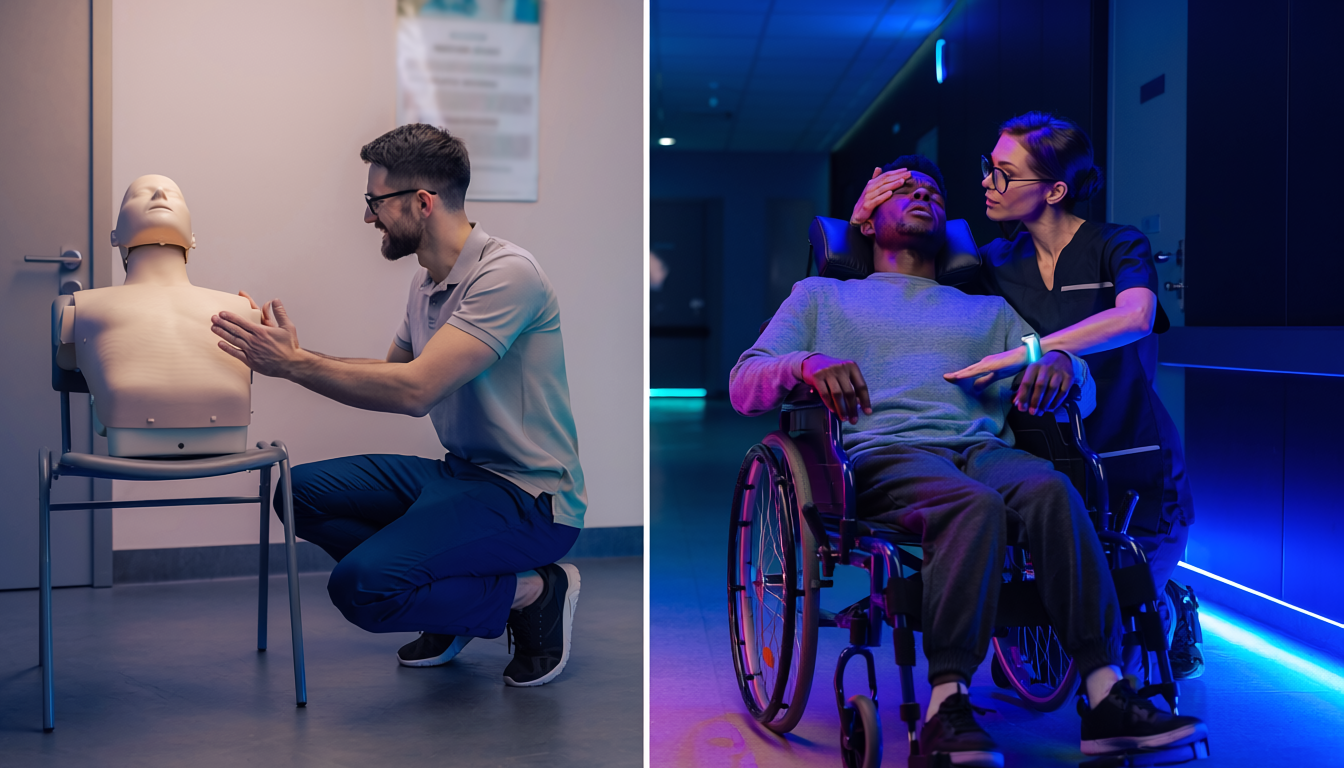
A participant with epilepsy has a tonic-clonic seizure while in their wheelchair. Standard first aid teaches recovery position on the floor, not how to manage a seizure in a wheelchair or mobility device.
Falls on Blood Thinners
An aged care resident on Warfarin falls and hits their head. A standard course doesn’t cover how anticoagulant medications dramatically increase internal bleeding risk.
Mental Health Crisis
A young person in residential care is in acute psychological distress and has self-harmed. Standard first aid doesn’t cover trauma-informed de-escalation or crisis response with minors.
Communication Barriers
A non-verbal participant using AAC is choking. Standard courses assume the casualty can tell you what’s wrong. Many of the people care workers support cannot.
Dementia-Sensitive Response
A resident with advanced dementia is showing signs of stroke but becomes agitated when you approach. Standard first aid doesn’t address cognitive impairment in emergency assessment.
Lone Worker Emergencies
A community support worker is alone with a client who collapses in a home visit. Standard first aid assumes help is nearby. Community workers often operate with zero backup.
11270NAT Closes the Gap
Support Care Training’s 11270NAT course was built from the ground up to address the exact scenarios that generic first aid ignores. It doesn’t replace your standard HLTAID011; it builds on it with the sector-specific skills your role actually demands.
Real Sector Scenarios
Every training scenario is drawn from real incidents in aged care, disability, youth services, and community health settings.
Adapted Techniques
CPR for wheelchair users. Seizure management with mobility equipment. Choking response for non-verbal individuals.
Nationally Accredited
Not a workshop or CPD add-on. 11270NAT is a full nationally accredited course under the Australian Qualifications Framework.
CPD Points Recognised
Count towards ongoing professional development across AHPRA, aged care quality standards, and NDIS worker screening.
Standard First Aid vs. Support Care Training
This Affects Millions
Australia’s care sector is one of the fastest-growing workforces in the country, and it’s been trained with first aid designed for a different world.
Australians with Disability
Each relying on support workers who need to respond to their specific health needs.
Care Sector Workers
Across aged care, disability, youth services, and community health, all trained in generic first aid.
Unpaid Family Carers
Caring for a loved one at home with no formal emergency training at all.
Alternatives Until Now
Before 11270NAT, there was no accredited first aid course specifically designed for Australia’s care sectors.
If You Work in Care, This Is for You
Disability Support Workers
Managing seizures, behavioural incidents, medication emergencies, and adapted emergency response for participants with complex needs.
Aged Care Staff
Falls response, cardiac events, stroke recognition, pressure injury awareness, and dementia-sensitive emergency care protocols.
Youth Workers
Mental health crisis response, trauma-informed care, substance-related emergencies, and de-escalation in residential and outreach settings.
Community Health Workers
Lone worker safety, field-based emergency response, complex needs triage, and community-setting first response without backup.
Family & Unpaid Carers
Practical, jargon-free emergency training for families caring for someone at home: the 1.2 million Australians the system often overlooks.
Support Coordinators & Managers
Build workforce capability with sector-relevant training that improves confidence, decision-making, and real-world response in complex care settings.